
The demand for rapid application development has transformed low-code platforms from niche IT tools into enterprise necessities. Faced with developer shortages and the relentless pressure to digitise, organisations are turning to low-code to bridge the gap between business needs and IT capacity.
While the market is dominated by a few recognisable global heavyweights such as Microsoft, OutSystems, Mendix, and Appian – there is a growing appetite for platforms that offer a more targeted, customer-centric, and cost-predictable approach. One such contender making significant waves, particularly in the UK and across the public and customer-service sectors, is Liberty Create by Netcall.
In this market comparison, we explore how Netcall’s Liberty Create compares to the main low-code platforms, examining where it excels and where the legacy giants still hold their ground.
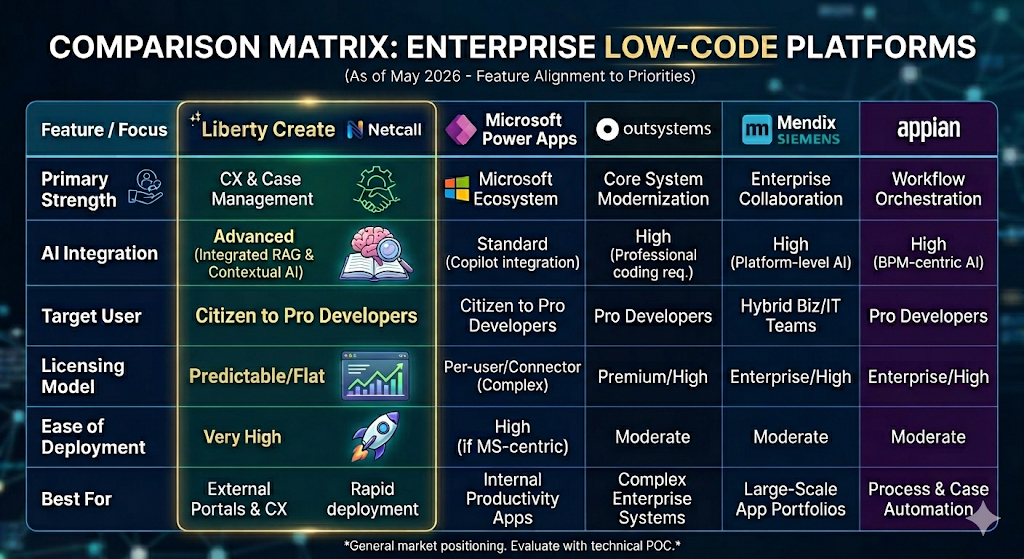
Comparison Matrix: Enterprise Low-Code Platforms
To help you visualise how these platforms align with different organizational priorities, the table below summarizes the key differentiators.
The Industry Heavyweights: The Big Four
To understand where Liberty Create fits, we must first look at the platforms that have traditionally defined the enterprise low-code market.
1. Microsoft Power Apps: The Ecosystem Giant
- The Pitch: If you use Office 365, you already have access to Power Apps. It is the ultimate citizen developer tool, designed to integrate seamlessly into the Microsoft ecosystem.
- Strengths: Unparalleled integration with Microsoft Dataverse, SharePoint, and Dynamics. It allows organisations to spin up internal productivity apps in hours.
- Weaknesses: While great for simple internal forms, scaling Power Apps for complex, external-facing customer portals can be surprisingly difficult. Furthermore, licensing costs can spiral unpredictably when utilizing premium connectors or scaling to external users.
2. OutSystems: The Enterprise Powerhouse
- The Pitch: OutSystems is built to replace traditional coding entirely, even for mission-critical, highly complex enterprise software.
- Strengths: Exceptional performance, deep architectural control, and complete Application Lifecycle Management (ALM). It is the platform of choice for modernising massive legacy core systems.
- Weaknesses: It comes with a premium price tag and a steep learning curve. The complexity of OutSystems means it is generally a tool for professional developers rather than everyday business users.
3. Mendix (by Siemens): The Collaborative Architect
- The Pitch: Mendix focuses heavily on breaking down the silos between business analysts and IT developers through a shared visual language.
- Strengths: Robust enterprise architecture, excellent mobile and offline capabilities, and strong support for microservices.
- Weaknesses: Similar to OutSystems, Mendix represents a massive enterprise investment. Deployment and contracting can be complex, and the platform can be overkill for organisations simply looking to build workflow or case management tools quickly.
4. Appian: The Process Master
- The Pitch: Appian’s roots are in Business Process Management (BPM). It excels at orchestrating complex workflows, rules, and case management across an enterprise.
- Strengths: Phenomenal workflow orchestration and data fabric capabilities. It is highly secure and excellent at tying together disparate legacy systems into a single view.
- Weaknesses: UI customization is notoriously rigid; you build apps the Appian way. It is also heavily priced toward large-scale enterprise deployments.
The Challenger: Netcall Liberty Create
Against these global giants stands Liberty Create, Netcall’s low-code application platform. Originally establishing a dominant footprint in the UK public sector (NHS, local government, social housing) and regulated industries, Liberty Create has evolved into a formidable enterprise platform focused on customer experience (CX), case management, and agile delivery.
Where Liberty Create Excels
1. A Genuine Business & IT Bridge
While OutSystems caters to pro-developers and Power Apps to internal citizen developers, Liberty Create strikes a highly pragmatic balance. It features a Build Studio with intuitive drag-and-drop tools for business technologists, alongside a Code Studio where professional developers can inject custom JavaScript and API integrations. This ensures that business users can prototype and build 80% of an app, while IT handles the complex 20%.
2. Speed to Value and Deployment
In recent Gartner Peer Insights reviews, users consistently scored Liberty Create higher than both OutSystems and Mendix in Ease of Integration and Deployment. Netcall boasts that users can go from a blank canvas to a working application in weeks, if not days, supported by rapid 3-day onboarding courses and a thriving community AppShare full of pre-built accelerators.
3. Superior Focus on Customer Experience and Case Management
Liberty Create is purpose-built for external-facing journeys. Whether it’s a Citizen Hub for a local council, a Patient Portal for healthcare, or a complex customer service desk, the platform excels at case management. When combined with Netcall’s wider suite – such as Liberty Converse (contact-center) and Liberty RPA (robotics) it provides an end-to-end customer engagement architecture that platforms like Power Apps simply don’t offer natively.
4. Intelligent Context with AI and RAG-Powered Workflows
Beyond its low-code development capabilities, Netcall has integrated a powerful AI layer across the Liberty platform. This differentiates Liberty Create from traditional form-and-workflow tools by transforming static applications into dynamic, intelligent assistants.
5. Commercial Transparency and Cost Predictability
One of the most frequent complaints about platforms like Appian and Power Apps is the complex, consumption-based, or per-user licensing that penalizes success. Liberty Create frequently wins on evaluation and contracting because of its more transparent, predictable licensing models (often utilizing flat platform or server licenses), making total cost of ownership (TCO) much easier to manage – especially for apps with thousands of external users.
Where the Heavyweights Retain the Edge
Liberty Create is highly capable, but it isn’t a silver bullet for every scenario:
- Deep Ecosystem Lock-in: If an organization is strictly utilising Microsoft Azure and wants deep, native ties into Microsoft Teams, SharePoint, and Active Directory, Power Apps will naturally provide less friction.
- Core System Replacement: If the goal is to build a high-frequency algorithmic trading platform or replace a multinational banks core mainframe from scratch, the raw, heavy-duty architectural scaling of OutSystems or Mendix remains the industry standard.
- Global Footprint: Mendix and OutSystems boast massive global systems integrator (SI) networks. While Netcall is expanding, its center of gravity and strongest support networks remain heavily concentrated in the UK and European markets.
The Verdict: Which Should You Choose?
The choice of a low-code platform should be dictated by your end goal, not just the feature sheet.
- Choose Microsoft Power Apps if your primary goal is to empower internal employees to build simple productivity tools and you want to leverage your existing Microsoft 365 spend.
- Choose OutSystems or Mendix if you have a massive IT budget, a team of professional developers, and a strategic mandate to rebuild heavy legacy architectures from the ground up.
- Choose Netcall Liberty Create if your priority is customer or citizen experience. If you need to rapidly deploy robust case management systems, build external-facing portals, require predictable pricing without per-user penalties, and want a platform that truly allows business teams and IT to collaborate effectively, Liberty Create is arguably the smartest investment on the market today.
As the low-code market matures, the biggest platform isn’t always the best fit. Agility, vendor transparency, and speed-to-value are becoming the true metrics of success – metrics where Liberty Create is quietly outperforming the giants.